Why the Snacks You Keep for Emergencies Often Become the Reason You Need Them Every Day
Emergency snacks shift from safety net to daily habit through a predictable pattern you can interrupt without giving them up entirely.
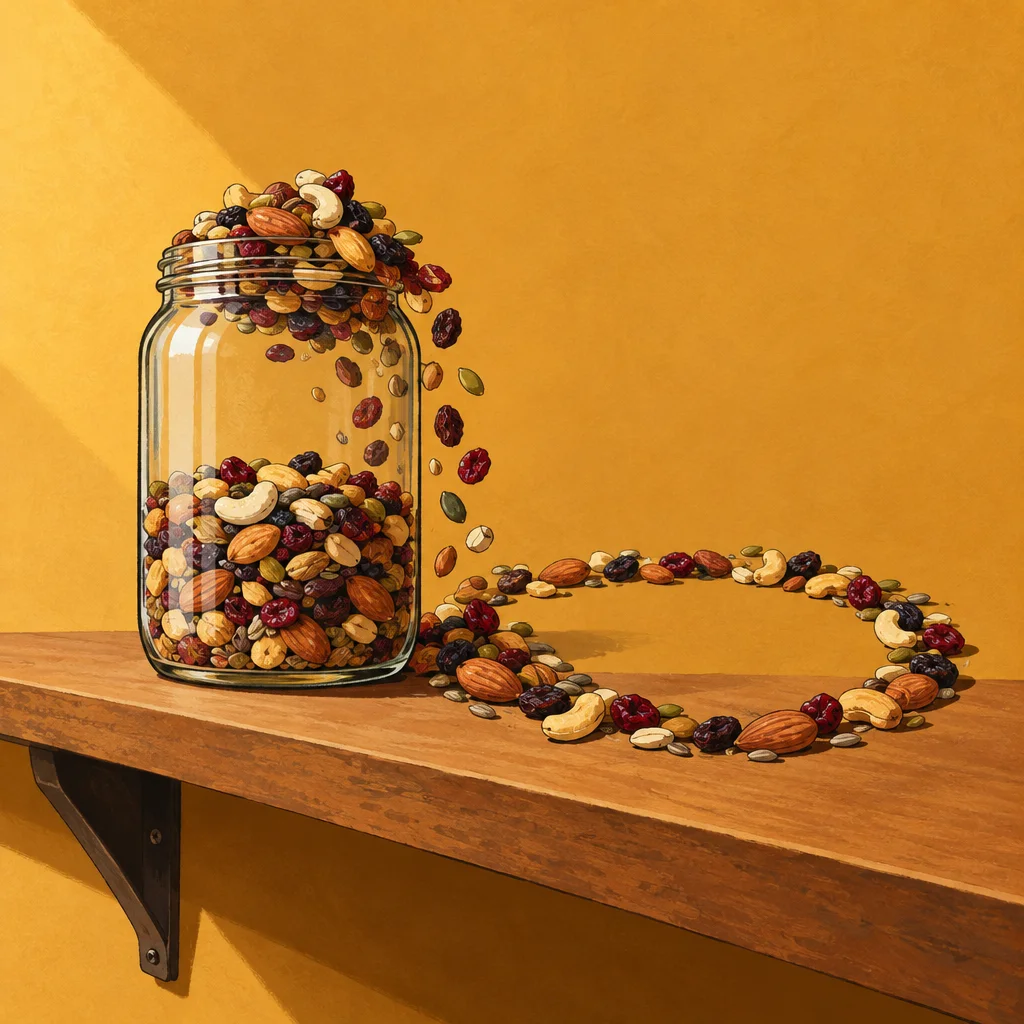
Most people who are actively trying to lose weight keep something around for emergencies. A handful of nuts in the bag. A protein bar in the desk drawer. A small piece of chocolate in the car console. The logic makes sense: have something reasonable nearby so you do not end up at a drive-through at six in the evening.
That logic is not wrong. The problem is what tends to happen next.
How the Emergency Snack Becomes a Scheduled Snack
When you keep a specific food around for a specific purpose, your brain begins to associate that food with that time and place. A protein bar in the desk drawer gets eaten on Tuesday when you skip lunch. It helps. So on Wednesday, you think about it around the same time. By Friday, you are eating it regardless of whether you were actually in an emergency.
This is not a willpower failure. It is how habit formation works. Cue, routine, reward. The cue was originally hunger and desperation. Over time, the cue becomes the desk, the afternoon, the slight dip in energy that always happens after two o'clock. The bar is there. You eat it. You feel fine. The loop closes.
None of that is catastrophic on its own. The issue is that the emergency snack was never planned as a daily addition to your calories. It was insurance. When it becomes routine, those extra calories show up in your total without showing up in your mental accounting.
Why You Do Not Notice It Happening
Emergency snacks tend to be modest in size by design. You chose something small on purpose. That modesty is part of why the habit sneaks in. A two-hundred-calorie protein bar does not feel like a decision worth examining. It feels like nothing.
But if that bar goes from occasional to daily, that is roughly fourteen hundred extra calories per week that were never part of your plan. Over a month, that addition can slow or stall real progress without you ever identifying why.
The math is not the whole story, either. The habit also reinforces a pattern of eating in response to time and environment rather than actual hunger. That pattern, once established in one context, tends to spread to others.
How to Tell If This Is Happening to You
You do not need to track every calorie to catch this. Ask yourself three questions about any food you keep around as a backup.
First: when did I last skip it? If you cannot remember a day you left it untouched, it is no longer an emergency snack. It is a meal.
Second: do I reach for it before checking whether I am actually hungry? If the answer is usually yes, the cue is environmental, not physiological.
Third: did I plan for it in my eating for the day? If it consistently falls outside your plan, it is worth deciding whether it belongs inside the plan instead.
None of these questions are accusations. They are diagnostics. The goal is clarity, not guilt.
Two Ways to Handle This Without Giving Anything Up
Option one is to promote the snack. If you are eating it every day anyway, put it in your actual plan. Decide it is part of your lunch or your afternoon deliberately, account for it, and stop treating it as an extra. Many people find that the moment they make the snack official, they eat it with more attention and enjoy it more. Sometimes they eat it less often because the urgency of having it available fades.
Option two is to change the friction. Emergency snacks work partly because they are within arm's reach. If you move them one step further away, not out of the building, just out of the immediate environment, you create a small pause between the cue and the action. That pause is often enough to let a genuine hunger check happen. Put the nuts in a cabinet instead of on the desk. Leave the car snack at home if you know you are driving a short route. Small friction is not deprivation. It is a reset.
You can also try both: plan the snack intentionally on days you know you will need it, and reduce its automatic availability on days you probably will not.
What to Keep Around Instead, and Why It Matters
If you do want a genuine emergency option, the most useful one is something that requires a little preparation before you can eat it. Not significant effort, just enough that you would not do it on autopilot. A piece of fruit you have to wash. Yogurt you have to open and spoon. Vegetables you have to rinse.
The extra ten seconds is not about making it unpleasant. It is about inserting a moment of awareness before the eating starts. That moment is where the actual decision lives.
Foods that require zero steps, unwrapping included, tend to disappear fastest and leave the least sense of satisfaction behind. Slower eating starts before the first bite.
The Bigger Pattern Worth Recognizing
Emergency snacks are a small version of a larger dynamic in diet change: the things you put in place to help you succeed can gradually become the things that hold you in place. A backup plan that fires every day is no longer a backup. A rule you created to protect yourself can start protecting the habit you were trying to build around instead.
Checking in on your safety nets periodically is not paranoia. It is honest maintenance. Your circumstances change, your hunger patterns change, your schedule changes. A snack strategy that made sense in month one of a new eating plan may not fit month four the same way.
This is not about perfection or strict rules. It is about staying curious about what you are actually doing versus what you think you are doing. That gap is where most diet drift lives, and it is almost always closable once you can see it clearly.