Why the Way You Cook Your Vegetables Changes How Many Calories Your Body Actually Absorbs From Them
Cooking method changes the structure of plant foods in ways that shift how many calories your body can extract from each serving.
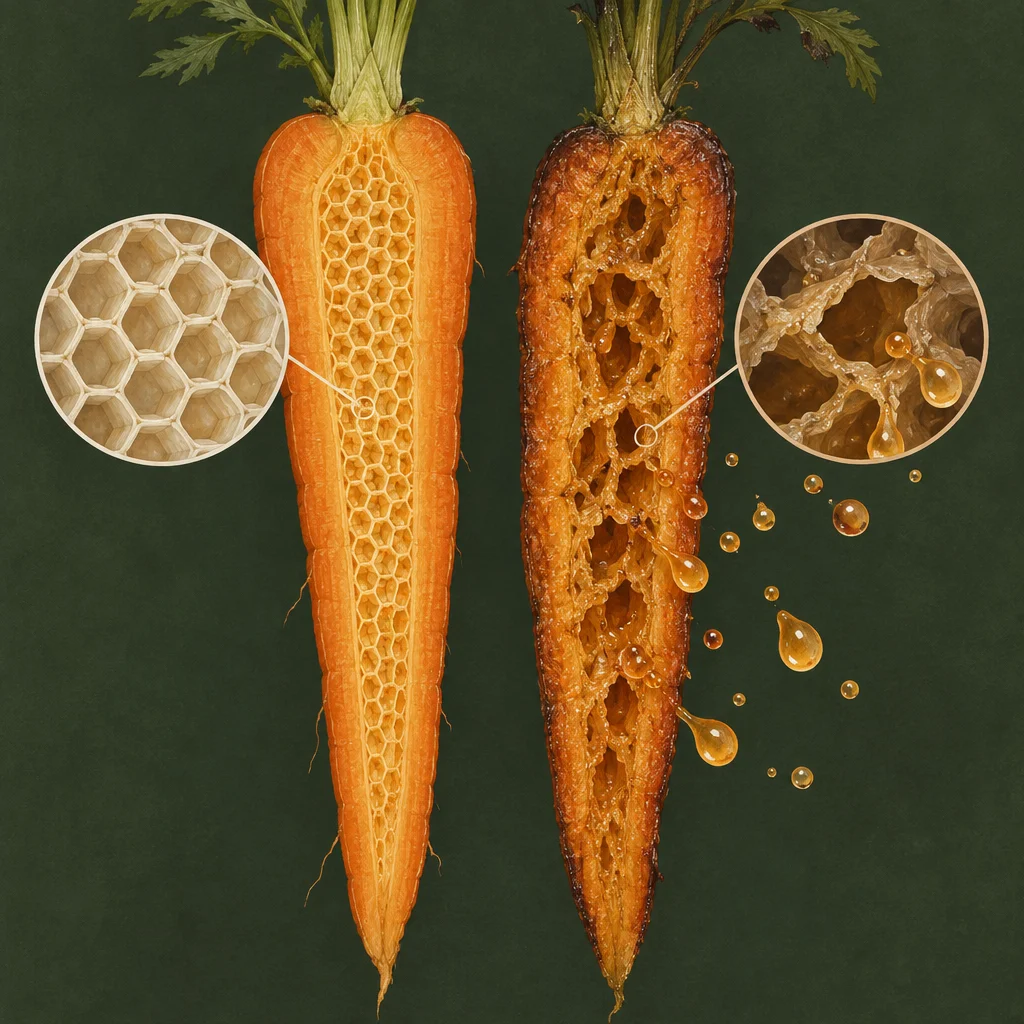
Most people tracking vegetables treat a cup of carrots as a cup of carrots, regardless of whether it came raw from a bag or roasted in the oven for forty minutes. The calorie count on the label stays the same. Your body, however, does not read labels.
How you prepare a vegetable changes its physical and chemical structure, and that structure determines how much your digestive system can break it down and absorb. The number on the label is an average estimate of potential energy. What your body actually captures is a different number, shaped by cooking time, heat, and the amount of processing the food went through before it reached your fork.
Why raw food is harder to digest, in a useful way
Plant cells have walls made of cellulose, a tough material your body cannot digest at all. Raw vegetables keep those walls largely intact. To get at the nutrients and calories inside, your gut has to work harder. Some of that work means calories that never make it into your bloodstream.
Cooking softens and breaks down cell walls. It gelatinizes starches, which makes them more available to digestive enzymes. A raw carrot and a fully cooked carrot have the same number of calories listed on paper, but the cooked version delivers more of those calories because the structural barriers have already been dismantled. This is not a large difference on any single meal. Across months of consistent eating, it is a pattern worth knowing about.
What this means for your vegetables in practice
The takeaway is not that you should stop cooking vegetables. Cooking also increases the availability of many beneficial compounds, makes vegetables easier to chew in large quantities, and often makes them far more appealing to eat regularly. A diet you stick to beats a theoretically optimal diet you abandon.
The practical point is gentler: if you are already eating a significant volume of vegetables and wondering why your results have stalled, rotating more of them into raw or lightly prepared form is a low-effort adjustment worth trying. Swapping one fully roasted or sauteed vegetable portion per day for the same food raw, lightly steamed, or just blanched is a genuine change, not a tortured workaround.
Cooking fat adds up faster than the cooking method adjusts
Here is the honest counterweight to everything above. The calorie difference between a raw vegetable and a plain cooked one is modest. The calorie difference between a plain cooked vegetable and one cooked in two tablespoons of olive oil is not modest at all. A generous pour of oil or a knob of butter adds more calories than the cooking method removes.
If your current habit is roasting vegetables heavily dressed in oil, the more impactful adjustment is the oil, not switching to raw. A light toss rather than a heavy coat, or roasting with a minimal amount, will do more work than any nuance about cell wall breakdown.
Both variables are real. Start with the one that moves the needle more.
Resistant starch is a related concept worth knowing
When cooked starches, like those in potatoes or grains, are cooled down after cooking, some of the starch converts into what is called resistant starch. Resistant starch behaves more like fiber than like a regular carbohydrate. Your small intestine cannot break it down easily, so fewer calories from that portion enter your system, and the material feeds gut bacteria instead.
This is why a cold potato salad made from cooked-and-cooled potatoes behaves somewhat differently in your body than a hot baked potato, even at the same portion size. If you regularly eat rice, potatoes, or pasta, cooking them ahead and eating them cold or reheated once cooled is a small structural change that accumulates over time. It does not transform these foods into free calories, but it shifts the equation slightly and adds fiber-like benefits at the same time.
A few concrete suggestions for using this
Think about your highest-volume vegetables and where they currently sit on the cooking spectrum. Spinach that gets wilted into a dish is fine, but raw spinach in a salad delivers fewer usable calories from the same handful. Broccoli that is steamed just until tender retains more of its fibrous structure than broccoli cooked until very soft.
None of this requires giving up warm, satisfying food, especially in colder months when a bowl of roasted vegetables is what actually gets eaten. A reasonable approach is to keep cooked preparations where you need them for adherence and enjoyment, and add raw or lightly prepared versions where they are just as appealing to you personally.
As a hypothetical example: if someone currently eats all of their vegetables fully cooked, shifting two or three servings per week to raw preparation, and reducing cooking oil by half on the rest, could represent a meaningful calorie adjustment over a month without changing food volume at all. That is the kind of quiet correction that compounds.
What this does not mean
This is not an argument that cooking is bad for you, or that raw diets are superior. Both claims would be false. Cooking makes many nutrients more available, not less, and certain vegetables are genuinely better for you cooked than raw.
This is also not a reason to track cooking methods obsessively. Food tracking is already effortful enough. The goal here is awareness, not a new spreadsheet column.
The useful mental shift is simply this: the same food prepared differently delivers a different experience in your body. Knowing that gives you one more lever to work with, one that requires no special equipment, no extra money, and no willpower at all once it becomes a default habit.