Why the Size of the Serving Dish You Use Changes How Much You Eat Before Your Brain Notices
The physical size of bowls, plates, and spoons quietly sets an expected portion before hunger or intention gets a vote.
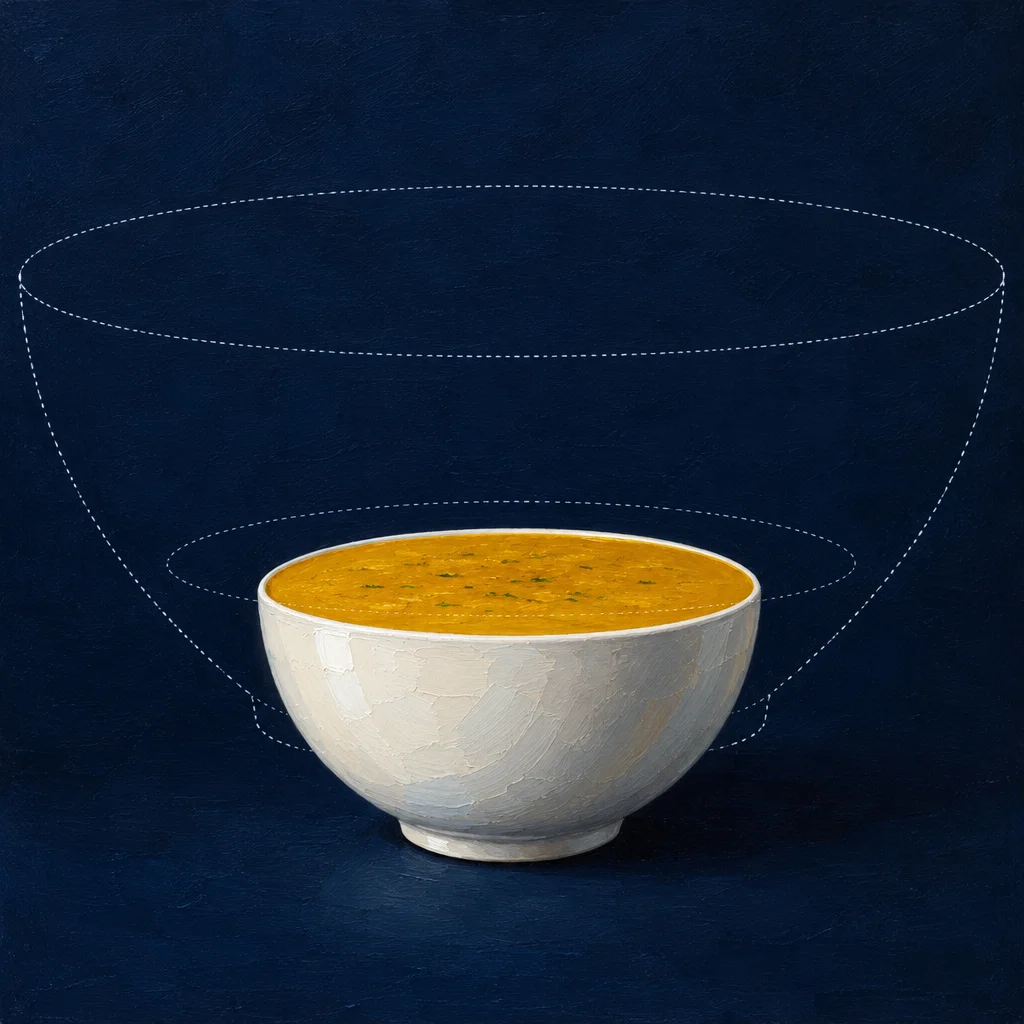
Most of us believe we decide how much to eat based on hunger. The research picture is messier than that. A meaningful share of how much food ends up in front of you, and then in you, is decided earlier, by the size of the vessel you are serving from.
This is not a character flaw. It is how visual perception works. Your brain uses the container as a reference point and reads a half-full large bowl as less food than a full small bowl, even when the actual amount is identical. The signal that says "this looks like a reasonable portion" fires before you taste a single bite.
Understanding this mechanism practically, not as a guilt trip but as a lever, gives you a concrete way to reduce intake without fighting hunger directly.
What Is Actually Happening
Your sense of how much you have eaten is shaped by multiple signals: taste, chewing, time, stomach stretch, and visual feedback. Of those, visual feedback arrives first and does a lot of heavy lifting early in a meal, before the slower signals have time to catch up.
When you serve yourself from a large bowl, the portion that looks normal to your eye tends to be larger than what a smaller bowl would suggest as normal. Your hand stops scooping at a visually familiar level, not at a calorie count you have calculated. This happens quickly and mostly outside conscious awareness.
The same dynamic applies to serving spoons. A larger spoon moves more food per scoop, and because people tend to take a predictable number of scoops rather than a precise weight, a spoon swap changes how much lands on the plate without changing the intention behind the action.
Why This Matters More for Calorie-Dense Foods
For foods that are high in fiber and water, like salad greens or steamed broccoli, the serving-size effect matters less. You would have to eat an impractical amount to significantly overshoot on calories.
The effect matters most for calorie-dense foods: pasta, rice, granola, nuts, cheese, nut butters, oils, and anything you scoop or pour. These are foods where a modest visual difference in portion translates into a meaningful calorie difference. An extra large handful of granola can add 150 calories that felt like the same amount as the intended serving.
If you are tracking calories and finding that your logged numbers do not match your results, serving dish size is one of the first practical places to look.
A Straightforward Practical Audit
You do not need to buy anything to test this. Start by looking at what you are currently using.
Measure the diameter of your everyday dinner plate. Plates have grown considerably over the past few decades, and a plate in the 11-to-12-inch range holds noticeably more food than one in the 9-to-10-inch range before it looks full. If your plates are large, using a salad plate as your dinner plate for calorie-dense meals is a free adjustment worth trying for a week.
Look at the bowls you use for cereal, oatmeal, pasta, or soup. Wide, shallow bowls and deep, capacious bowls both feel like normal bowls, but they hold very different volumes. If you are not sure, fill your current bowl with water and pour it into a measuring cup. The number may surprise you.
Check your serving spoons, especially for grains and starches. Swapping a large serving spoon for a smaller one at the pot or pan before the food reaches your plate is a low-friction change.
What to Do With This Information
The goal is not to eat off tiny dishes that leave you hungry and resentful. That approach backfires because it removes satisfaction without addressing appetite, and satisfaction matters for sustainability.
The more useful strategy is to be deliberate about which dishes hold which foods.
For calorie-dense sides and starches, a smaller plate or bowl is worth trying. For vegetables, salads, and high-fiber foods, a larger bowl works in your favor because it encourages you to fill it and feel satisfied by the volume.
For foods you pour or scoop, like breakfast cereals, nuts, or granola, consider serving yourself into a small bowl and putting the container away before you start eating. The act of returning to get more is a small friction point that gives your brain a moment to reassess whether you are actually still hungry. That pause is often enough.
If you share meals with family and serve from central dishes at the table, the same logic applies to the serving vessel and spoon at the center of the table, not just what is on your plate.
A Note on Tracking and Trust
If you use a food diary or calorie tracking app, visual estimation is the weakest link in the system for most people. Switching to a food scale for the specific foods that tend to be underestimated, typically nuts, oils, grains, and cheese, is the most reliable fix. But if a scale feels like too much, changing the serving vessel is a practical second-best that reduces the gap between what you pour and what a portion actually is.
Neither approach requires perfection. The point is to close the gap between intention and outcome with a structural change rather than relying on willpower at the moment of serving.
The Takeaway
Your dishes are not neutral. They carry quiet instructions about how much food looks right, and your hand tends to follow those instructions before hunger weighs in.
You do not need new dishes, a complicated system, or precise calorie math to use this. Pick one calorie-dense food you eat regularly. Serve it in a smaller vessel for two weeks. Notice whether the amount feels satisfying or genuinely insufficient. Adjust from there.
Small structural changes like this are worth pursuing precisely because they work without requiring daily decision-making. You make the change once and it keeps working quietly in the background, which is exactly the kind of effort that holds up over time.