Why the Grocery Store Path You Walk Each Week Quietly Decides What You Eat for the Next Seven Days
The route you take through a supermarket shapes which foods land in your cart before you make a single conscious choice about eating.
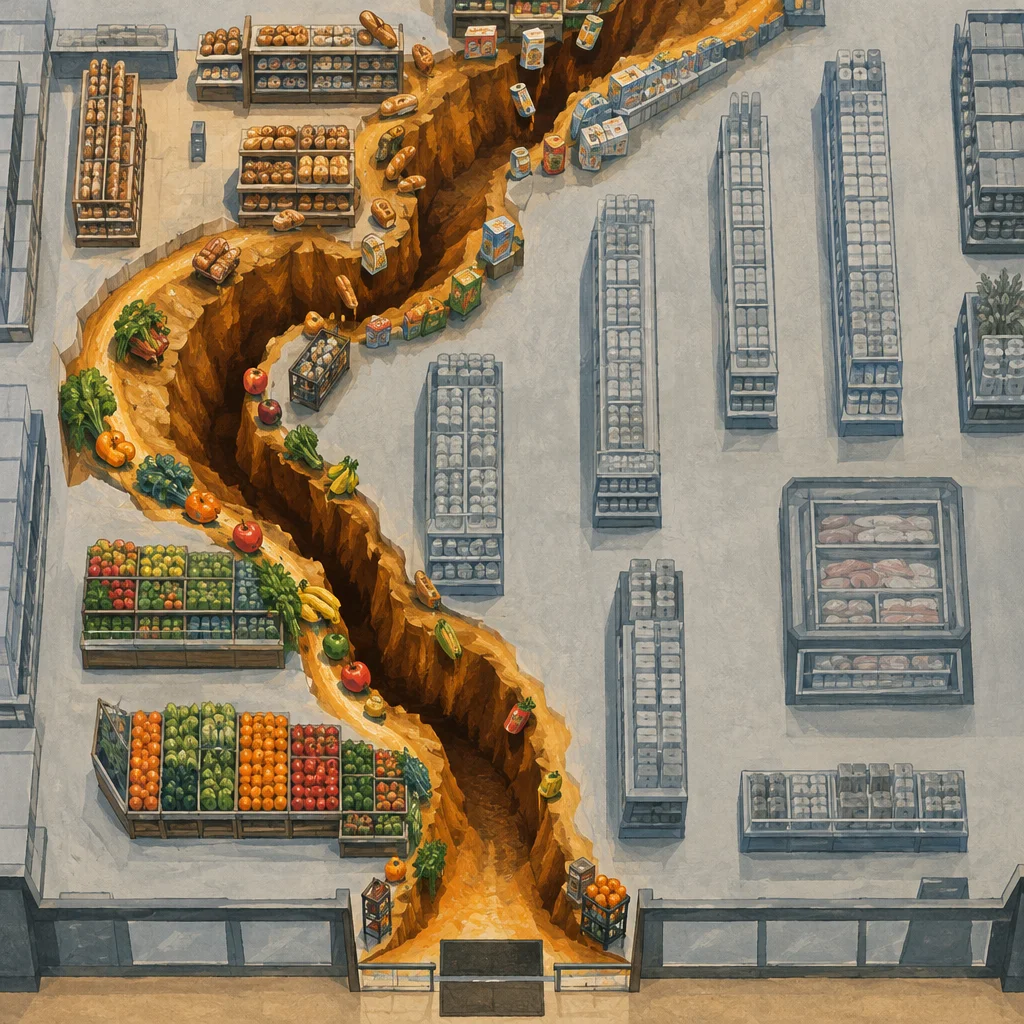
Most people think of grocery shopping as a neutral errand. You go in, you pick what you need, you leave. But the layout of a typical supermarket is not neutral at all, and neither is the path you walk through it. The sequence in which you encounter food categories has a quiet but real influence on what ends up in your cart, and therefore on what you eat for the rest of the week.
This matters for weight loss because your kitchen is where your diet actually lives. Willpower at the table is far easier when the fridge is stocked in your favor. The grocery trip is where that setup begins or breaks down.
Why the path matters more than the plan
Most supermarkets are designed with a few consistent principles. High-margin, processed, and impulse-friendly foods appear at eye level and near aisle ends. Produce is often placed at the entrance, but most shoppers move through it quickly before their cart is full and their decision energy is fresh. By the time many people reach the snack and bread aisles, the cart already has some weight to it, and the implicit sense that "the healthy stuff is handled" can make it easier to add things that were not on the list.
Your decision quality tends to shift over the course of a shopping trip. Early choices feel deliberate. Later choices, especially when you are tired, hungry, or mentally full from other decisions, tend to follow familiar habit patterns. If your familiar habit is to pick up chips or cookies in the last third of the store, you will probably keep doing it unless you interrupt the sequence.
The single most useful change
Shop the perimeter first, thoroughly, before entering any center aisle. This is not a new idea, but the reason it works is worth understanding. The perimeter of most grocery stores holds produce, proteins, dairy, and eggs. These are the foods that form the backbone of a practical weight-loss diet: filling, protein-rich, fiber-containing, and relatively low in the kind of processed calories that are easy to overeat.
If you fill the majority of your cart with perimeter foods first, two things happen. Your cart looks and feels substantial, which reduces the psychological pressure to keep adding things. And you have already mentally committed to a week of eating built around those foods, which makes impulse additions feel more like disruptions to a plan rather than additions to an empty space.
A suggested route for a typical store
This will vary by layout, so treat this as a starting framework rather than a fixed rule. Begin with produce. Spend real time here and make actual decisions about vegetables and fruit for the week rather than grabbing one or two things on the way past. Move to the meat or fish counter next and pick your protein sources for the week. From there, hit the dairy section for eggs, plain yogurt, or whatever fits your eating approach. If the store has a bulk or legume section, that is worth a stop before the center aisles.
Only then, with a cart that already reflects a week of solid meals, move into the center aisles for the specific shelf-stable items you genuinely need: canned beans, olive oil, oats, whole grain bread, or whatever your plan calls for. You are shopping for specific items at this point, not browsing. That distinction is what changes the outcome.
Hunger and timing
You have almost certainly heard the advice not to shop hungry. The reason it is repeated so often is that it is genuinely true and genuinely overlooked. When blood sugar is low and hunger is active, the appeal of high-calorie, fast-eating foods increases in a way that is difficult to override with intention alone. A small snack before you go is not weakness or extra calories that ruin your plan. It is a practical tool that makes the next hour of decisions easier.
If possible, shop at a time when you are not rushed. A tight time window adds pressure that makes careful decisions harder. If the choice is between a careful shop on a slow Saturday morning versus a rushed shop after work on a hungry Thursday evening, the Saturday trip will tend to produce a better-stocked kitchen even if both trips cover the same list.
The list as a filter, not a cage
A written grocery list serves two purposes. The obvious one is remembering what you need. The less obvious one is giving you a reason to skip things that are not on it. When something tempting appears that was not on the list, the list creates a small moment of friction: do I actually want this enough to deviate? That friction is not about guilt or rigidity. It is about creating a pause between the impulse and the cart.
The most useful lists are organized by store section rather than by recipe or meal. When your list is sorted by where things physically are in the store, you move through the space intentionally rather than wandering back and forth, which is one of the main ways extra items end up in the cart.
What to do about the hard sections
Every shopper has a weakness aisle. For some people it is chips. For others it is the bakery. There is no shame in this; these products are engineered to be appealing and are placed where traffic is high. A practical strategy is to skip the aisles you do not need entirely rather than walking through them and relying on willpower. If you do not need anything from the cookie aisle, there is no rule that says you must walk past it. Route around it. The extra thirty seconds is worth it.
If there are specific items in difficult sections that are genuinely part of your eating plan, buy them last. An item you place in the cart at the end of a trip, with a full cart already decided, is easier to limit to one than an item that rides with you through the whole store suggesting other companions along the way.
The practical takeaway
Your diet does not start when you sit down to eat. It starts when you decide what to bring home. A deliberate grocery route, a list sorted by section, a small snack before you go, and a willingness to skip aisles you do not need are not complicated strategies. They are small structural choices that stack the week in your favor before the week even begins.