Why the Same Meal Feels More or Less Filling Depending on How Fast You Eat It
Eating speed directly controls which fullness signals reach your brain in time to stop you, and slowing down at three specific moments produces measurable results.
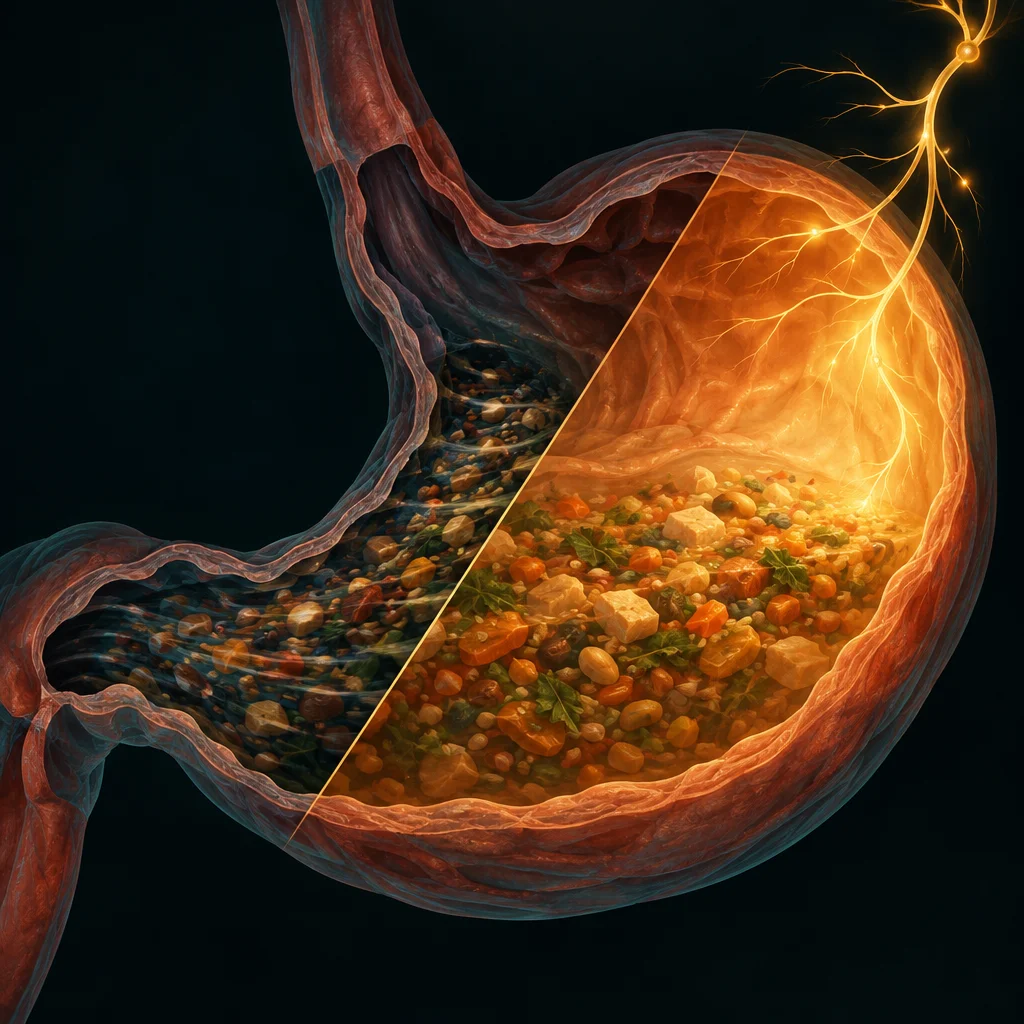
Most of us have heard "eat slower" at some point, usually delivered as a vague piece of advice that sounds obvious and changes nothing. The reason it rarely sticks is that nobody explains why speed matters at the biological level, or when during a meal slowing down actually pays off. Once you understand the mechanism, the advice becomes a concrete tool instead of a polite suggestion.
What Your Gut Is Actually Waiting For
Your stomach and small intestine contain specialized cells that release hormones when they detect food arriving. These hormones travel through your bloodstream to your brain and signal that eating can stop. The most studied of them, peptide YY and cholecystokinin, take roughly 15 to 20 minutes to build up enough concentration to noticeably reduce your sense of hunger.
That delay is not a flaw. It worked fine for most of human history, when food took real effort to obtain and chew. The problem is that modern meals, especially processed ones, can be consumed completely in under ten minutes. You finish the plate, the hormones have not yet arrived, your brain still registers hunger, and you reach for more.
Eating fast does not break the system. It simply outpaces it.
The Three Moments Where Speed Has the Biggest Impact
Slowing down across an entire meal can feel vague and hard to sustain. Focusing on three specific windows within a meal is more practical and delivers most of the benefit.
The first few bites. Your brain begins updating its hunger estimate the moment eating starts, partly through nerve signals from the stomach and partly through early hormone release. The first few bites are not neutral. Taking them slowly and chewing thoroughly starts the hormonal clock ticking a little earlier, which shifts the whole curve of the meal. Rushing the first bites, which many people do when they arrive at a meal very hungry, compresses the window in the worst way.
The midpoint pause. About halfway through a meal, a short pause of even 60 to 90 seconds gives early-arriving signals a chance to register before you decide whether to keep going at the same pace. This does not mean putting your fork down theatrically. It means taking a drink of water, having a brief conversation, or simply setting the fork down while you chew what is already in your mouth. Hunger that felt strong at the start of a meal sometimes shifts noticeably during this pause, which changes how much you want to eat in the second half.
The moment you think you might be done. Most people interpret "I could eat more" as a reason to eat more. The fullness signal your brain is looking for is not "I am stuffed." It is a mild reduction in interest, a slight drop in how appealing the food looks, a feeling that you are no longer actively hungry even if you are not yet full. That signal tends to show up subtly and gets overridden easily when you are eating quickly and distracted. Slowing down in the final minutes of a meal makes that quieter signal easier to notice.
Why Distraction Makes This Worse
Eating in front of a screen is extremely common, and it reliably increases how much people eat during a sitting. Part of that effect runs through speed: when attention is elsewhere, pacing goes unmonitored and bites come faster without awareness. But distraction also blunts the brain's ability to process the fullness signals that do arrive. You can be receiving the right hormonal message and simply not register it because your attention is divided.
This does not mean every meal needs to be a silent ritual. It means that eating while deeply absorbed in something else removes one of the main tools your body uses to tell you when to stop.
A Practical Way to Actually Do This
If you have tried "eat slower" before and it faded within a week, the issue was probably that the instruction had no structure. A few approaches that tend to hold up better:
Use a slightly smaller utensil for a couple of weeks. This is not a trick so much as a friction device. Smaller bites naturally slow pace without requiring constant mental effort.
Put something on the table that encourages pausing, a glass of water you actually drink between bites works well. The act of setting down a fork and picking up a glass creates a small break that adds up.
For one meal a day, eat without any screen or reading material. You do not have to turn dinner into a meditation retreat. Starting with one meal builds the habit without disrupting your whole routine.
If you find hunger feels urgent and leads to rushing at the start of every meal, consider whether you are arriving at meals too hungry. A small protein-containing snack in the afternoon, if dinner is your most rushed meal, can reduce the intensity of arrival hunger and make a slower pace easier to sustain.
What This Actually Produces Over Time
The benefit here is not dramatic on any single day. A slower meal might result in eating somewhat less, or it might not. What accumulates over weeks is a recalibration of portion intuition. People who consistently allow their fullness signals time to register gradually eat less not because they are restricting, but because their stopping point shifts. They are not white-knuckling through hunger. They are simply receiving information that was always being sent.
This is not a replacement for paying attention to what you eat. Calorie quality, protein and fiber intake, and meal structure all matter. But eating speed is an underused lever that works through real biology, costs nothing, requires no special food, and fits every budget and dietary pattern. That combination is rare enough that it deserves more than a passing mention at the end of a list.
Start with the midpoint pause. It is the easiest entry point, and if you notice anything at all during it, that noticing is the mechanism working.