Why the Way You Set Up Your Kitchen Determines What You Eat Before You Feel Hungry
The physical arrangement of your kitchen shapes your default food choices through visibility and friction before hunger or willpower ever enter the picture.
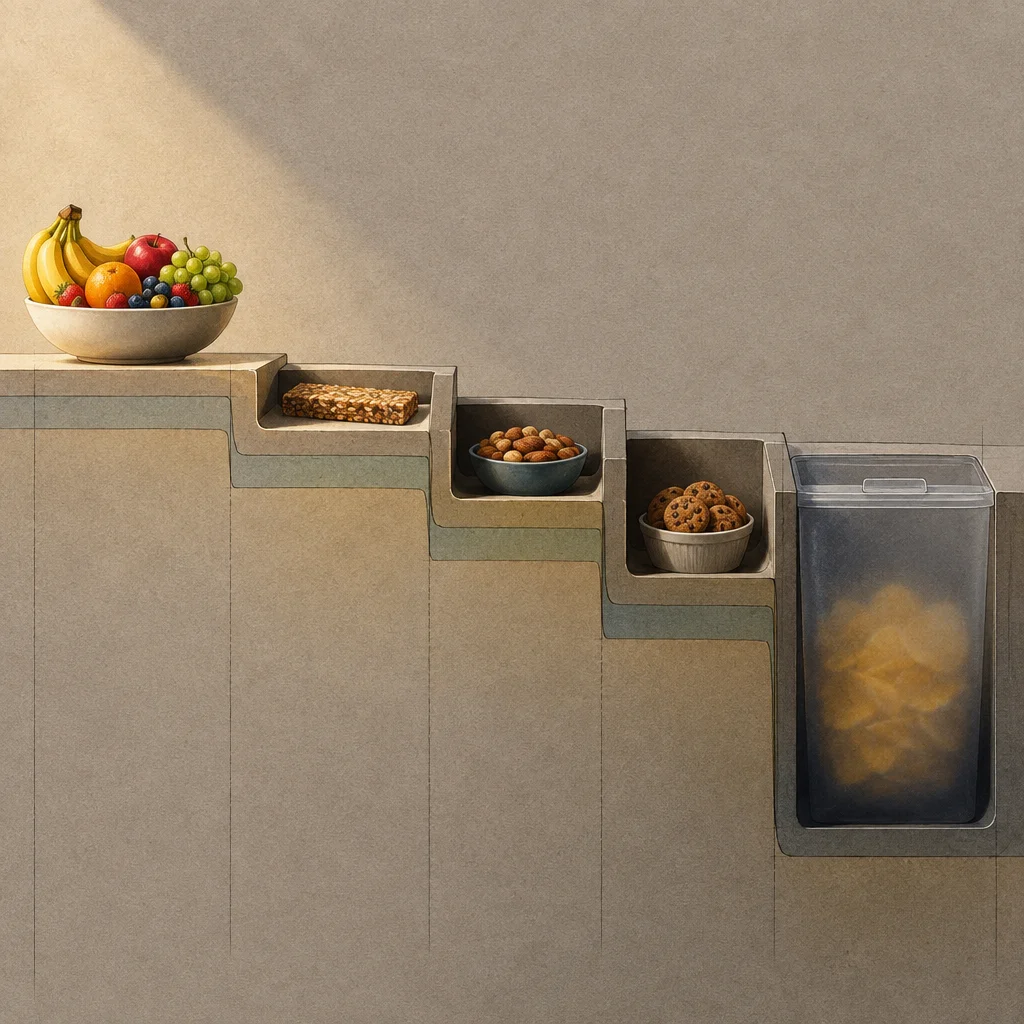
Most kitchen advice focuses on what to buy. Very little focuses on where to put it. That gap matters, because your kitchen layout is quietly making food decisions on your behalf dozens of times a week, mostly before you are consciously aware you are even making a choice.
This is not about willpower. It is about how human brains actually work: we reach for what is visible, we avoid what requires extra steps, and we default to whatever is positioned at eye level or within arm's reach. Rearranging your kitchen to work with those tendencies, instead of against them, is one of the lowest-effort changes you can make to your eating without touching your meal plan at all.
The countertop rule
Whatever lives on your countertop gets eaten most. This is not a judgment about self-control. It is just how proximity works. A bowl of fruit on the counter gets grabbed. A bag of crackers left out after snacking gets returned to repeatedly without a decision ever really being made.
A practical suggestion: do a single sweep of your countertop and remove everything that is not a whole fruit, a vegetable, or a cooking tool. Put other items in a cabinet or pantry. You do not have to throw anything away. You are just adding one step between yourself and a less intentional choice. That one step is often enough.
If bare countertops feel sparse, a bowl of apples, bananas, or oranges fills the visual space and gives you something to reach for between meals that is satisfying and fits most eating approaches.
Eye level in the fridge
When you open the refrigerator hungry, you will almost always take the first thing you see. This is partly biology and partly habit, but the effect is consistent enough to be worth designing around.
Try placing your highest-protein, most filling foods at eye level: cooked eggs, leftover chicken or fish, plain Greek yogurt, sliced vegetables, hummus in a clear container. Move less useful defaults like condiments, beverages, or items you are saving for specific meals to lower shelves or the door.
A useful test: open your fridge right now and notice what your eyes land on first. If the answer is leftovers you wanted to keep, a block of cheese, or nothing recognizable, that is information. You do not need to reorganize everything at once. Moving two or three items to the shelf that hits your line of sight when the door opens can shift your default grab meaningfully.
The two-container method for snacks
Keeping snacks visible but portioned is more sustainable for most people than hiding snacks entirely. Complete restriction often increases focus on the restricted item rather than reducing it.
A simple approach: keep two small containers at the front of a low-friction shelf, one with something protein-forward and one with something crunchy or satisfying to chew. Refill them once every few days from a larger package stored elsewhere. The separation between the portion in front of you and the larger supply behind a cabinet door is small, but it interrupts automatic eating long enough for a real decision to happen.
This is not about measuring or tracking unless you find that useful. It is about replacing a large, open package with a pre-set amount that prompts you to pause.
The hidden friction principle
Friction is not the enemy of a good kitchen. Applied deliberately, it is one of your most useful tools.
For example: if you keep a large bag of mixed nuts accessible because they are healthy, but you tend to eat three times what you intended, try moving them behind something else in the cabinet. The goal is not to make them disappear but to make grabbing them a two-step action. Most of the time, you will only go through both steps when you actually want them, not simply because your hand moved there automatically.
Apply the same logic to anything you eat mindlessly rather than intentionally. The question to ask about each item is: am I okay with myself eating this often and without much thought? If yes, keep it accessible. If no, add a step.
Plate and bowl size as a default portion guide
Plate size shapes how much food you serve yourself before you taste anything. This is well-established in behavioral research, and it does not require that you be unaware of it to have an effect. Even when people know they are using a larger plate, portion sizes tend to follow the available space.
You do not need to buy new dishes. But if your everyday plates are large and you are trying to reduce portions, using a smaller plate as your primary dish or filling a larger plate to a visible halfway line before adding more gives you a structural cue that costs nothing and requires no ongoing decision-making.
Bowls have the same dynamic. A wide, shallow bowl creates a different visual impression of the same volume than a narrow, deeper one. For soups, oatmeal, or grain bowls, using a taller, narrower vessel can make a reasonable portion look more complete.
One-time setup, ongoing return
The reason kitchen arrangement is worth investing time in is that you do it once and it keeps working. A meal plan requires daily decisions. A shopping list requires weekly effort. A kitchen layout change happens on a Saturday afternoon and then runs quietly in the background every day after.
You do not need to overhaul everything. Pick one area, the countertop, the fridge eye-level shelf, or your snack cabinet, and make one deliberate change. Notice for a week whether it shifts what you reach for. If it does, make another change.
The goal is a kitchen that defaults to your intentions instead of working against them. That is not a trick or a gimmick. It is just good design applied to your actual daily life.